
The Supreme Court’s ruling to allow West Virginia to discriminate against trans athletes is connected to a Texas lawsuit targeting disability rights

The Supreme Court
The Supreme Court in its current composition has made several decisions that have appeared to be a deliberate attempt to undo decades of social progress in the United States. In their most recent set of rulings, they have allowed states like West Virginia to ban trans women from participating in women’s sports. This ruling is bad in and of itself, but it is worth noting how it may be a harbinger of how the Supreme Court might rule on similar cases in the future.
The Republican Party in recent years has largely abandoned its rhetorical and political attack on abortion. It has replaced it with a coordinated string of antipathy towards trans people, specifically trans women, and the trans community as a whole. The Supreme Court’s ruling essentially blesses the discrimination of trans people using the power of government. This will have devastating effects on trans men and women, but this emnity is also being harnessed to endanger the rights of those within the disability community.
Section 504
Section 504 of the Rehabilitation Act of 1973, which uses language based on the language of the Civil Rights Act of 1964, is a foundational piece of legislation for the rights of members of the disabilty community. This legislation, which was signed into law by President Nixon, establishes that the discrimination and exclusion of people with disabilities from any program that is financed federally is illegal. Section 504 of the law begins by saying:
No otherwise qualified individual with a disability in the United States, as defined in section 705 (20) of this title, shall, solely by reason of his or her disability, be excluded from the participation in, be denied the benefits of, or be subjected to discrimination under any program or activity receiving Federal financial assistance or under any program or activity conducted by any Executive agency or by the United States Postal Service.
You can read the section in its entirety here
Among other things, this law ensures that people and students with disabilities are guaranteed appropriate accommodations in school and their workplaces. This can be anything from ensuring that someone with a peanut allergy is guaranteed a peanut-free space to eat their lunches, a vision-impaired student is guaranteed access to appropriate reading materials, or a person with a physical disability is guarnateed a work environment that is appropriate to their disability (i.e., ramps and accessible elevators for a person who has difficulty walking). This law is a bedrock upon which the laws that establish special education across the United States. While no law or system is pefect, the protections afforded by this legislation are a dramatic improvement over the alternative.
However, this law has had its opponents, especially those in the Republican Party. In 1984, the Supreme Court ruled that private institutions did not have to support students with disabilities in programs that were not directly supported by federal funds, which weakened its impact. The Reagan Administration also attempted to roll back the protections afforded by Section 504, though this was largely defeated through the the organizing of disability rights advocates.
Texas Lawsuit
Despite these setbacks, there have been efforts made to expand the coverage of the law. In 2024, President Biden extended the protections afforded under Section 504 to include students with “gender-identity based disorders.” This is where the connection between the ruling by the Supreme Court allowing state laws to discriminate against trans people becomes relevant. After the Biden administration extended these protections, Texas sued the Federal Government. However it should be noted that this lawsuit did not simply ask the courts to roll back Biden’s expanded protections under Section 504, an ask that would be terrible on its own. Texas, and the other Republican states that joined this lawsuit on Texas’ behalf, are asking that the entirety of Section 504 be declared unlawful.
Given the Republican Party’s history with disability rights, it seems clear that Republican politicians are attempting to harness the current hostility towards the trans community into achieving long-time held policy goals. While Nixon signed the Rehabilitation Act of 1973 into law, he was not exactly thrilled about it. This aversion to supporting the rights of people with disabilities in the community continues to this day. Recently, the Trump administration circulated a Department of Justice memo stating that the Olmstead decision, a Supreme Court case confirming the right of people with disabilities to be members of their community, to be invalid. While many advances have been made in increasing the rights of people with disabilities, those advancements are under assault.
Not All Bad News
However, the news is not all bad. Republican policies are largely unpopular. With how closely the Republican Party has tied itself to Donald Trump and his policy goals, you can see (as aggregated by G.Elliott Morris at Fifty Plus One) that Americans broadly disapprove of the Republican agenda and are likely to hold the Trump administration and the Republican Party accountable this fall. At the time of this writing (July 3rd, 2026), Donald Trump’s aggregated approval is at 37.5%.
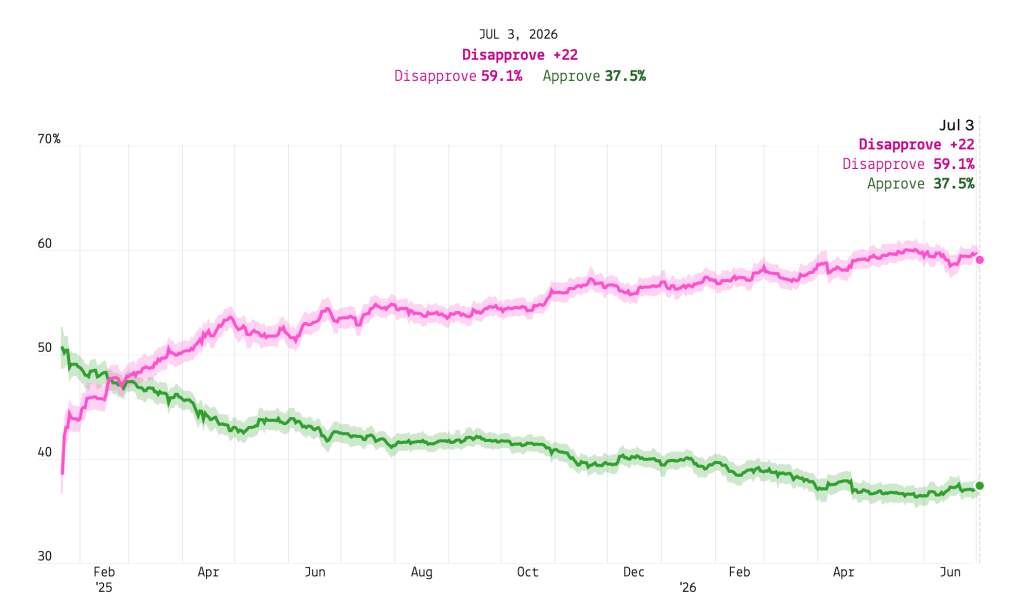
Likely because of this broad rejection, some Republicans are attempting to distance themselves from the President and his unpopular agenda. You can see an attempt in this lawsuit. While this lawsuit continues to circulate through the courts, Republican led states have begun to drop out of the lawsuit. Recently, both Kansas and Indiana, states whose governance is dominated by Republicans, have ended their support for this lawsuit.
However, since this lawsuit is still making its way through the court system, there is still a danger of courts ruling in Texas’ favor and ending protections for people with disabilites across this great nation of ours. Yet, the recent actions of Kansas and Indiana may be a sign that pressure, similar to the pressure put upon the Reagan Administration in 1984, may be effective in forstalling the worst impacts of this lawsuit. We should not have faith in how the courts, especially the Supreme Court, will rule, but instead place our faith in our own power to shape the politics that govern us.
Why This is Important
Unfortunately, throughout history, the disability community has been easy to ignore. They have often been placed, against their will, out of sight and out of mind. It is all too easy to view the needs of people with disability as separate from one’s everyday concerns. However, as discussed in this excellent podcast, disability comes for everyone. Whether it is by accident, illness, or old age, everyone will experience disability at some point in their lives. All of us, at one point or another, will rely on the protections of Section 504, and none of us would enjoy life without them.
But even if one does not experience disability, supporting disability rights would be a moral imperitive. The only way we can protect our own rights, especially when we are not a member of a vulnerable population, is to vigorously defend the rights of others. There is a very famous poem attesting to this.


One response to “Section 504 and Trans rights”
[…] These protests were organized in response to the government’s lack of implementation of Section 504 of the Rehabilitation Act which had been signed into law a few years prior by Richard Nixon. The act, signed in 1973, had yet […]
LikeLike