

Special Education is inherently political. Services that seem to be ubiquitous today seemed unobtainable not too long ago. The rights and protections afforded to students and people with disabilities are the product of organizers, parents, advocates, and disabled individuals themselves relentlessly demanding them. However, partially due to the stigmatization that is still placed upon those with mental and physical disabilities and partially to the fact that Black Americans took a prominent role in these efforts, these efforts are largely omitted from our nation’s history.
Section 504 Sit-ins of 1977

In 1977, there was a large sit-in movement to fight for these rights. These protests were organized in response to the government’s lack of implementation of Section 504 of the Rehabilitation Act which had been signed into law a few years prior by Richard Nixon. The act, signed in 1973, had yet to be implemented and, after four days of waiting, the American People began to speak up against it. The signing of the Rehabilitation Act into law without fully implementing Section 504 was seen as a betrayal of disabled Americans and disabled Americans and their advocates began to protest. The most prominent of these protests occurred in San Fransisco.
Brad Lomax, a disabled man using a wheelchair, urged the Black Panther Party to support the protests. Lomax was a Black Panther himself (as was his caretaker) and believed strongly in the in the protesters’ cause. As protesters occupied San Fransisco’s Civic Center Plaza, the Black Panthers provided the protesters with hot means, clean water, and other supports to prolong the protests in order to pressure elected officials, specifically wihtin the Carter Administration to fully implement Section 504. Because of these efforts, the protest lasted for 25 days.
While members of Jimmy Carter’s administration refused to meet with the protestors, the legacy of the efforts by these patriotic Americans furthered the cause of disability rights and led to the implementation of Section 504 and tangible improvements in the lives of disabled Americans. Dr. Frank Bowe, one of the organizers of the sit-ins, stated:
Without any question. There was a Lou Harris poll that was just released. They conducted a poll of 1,000 disabled Americans. This was the first national poll ever to ask people with disabilities about their lives. The overwhelming majority said their lives had improved greatly in the last decade, probably because of 504. But here’s my point: those of us who did it, and there were many of us, I don’t think we ever had a chance to have such a massive impact on the lives of tens of millions of people. That was a very unprecedented event. And that’s why I don’t think any of us ever experienced anything quite so great.
Brad Lomax passed away a few years after this victory at the all too young age of 34, but his legacy is something to admire. He founded the Washington DC Chapter of the Black Panther Party in 1969. His work supporting protesters in San Fransisco led to not only Section 504’s implementation, but to futher legislation guaranteeing rights and protections for disabled Americans.
The Olmstead Decision
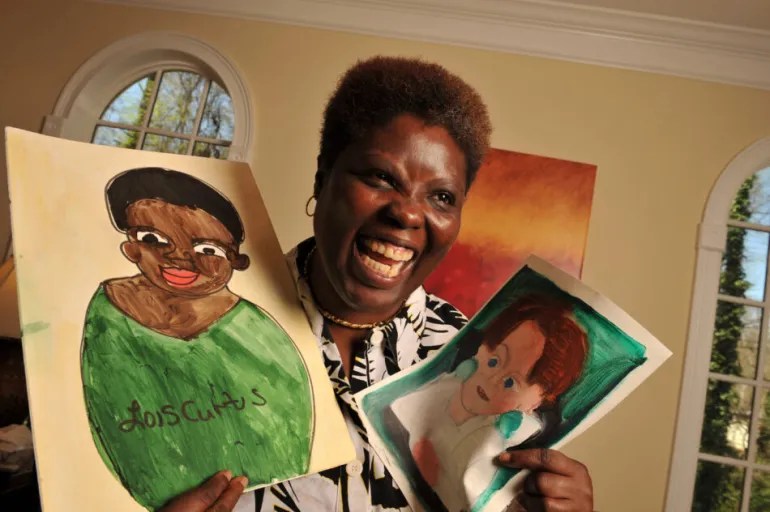
Lois Curtis was a woman from Georgia who was disagnosed with a cognitive disability and schizophrenia. As a child, she would frequently go missing from her home or school. Her mother would call the police to look for her, but these circumstances would often land Lois in jail rather than receiving support. As an adult, she lived in an institution and was denied access to her community.
While seeing disabled Americans out and about in the community has become more commonplace in American society, people with mental disabilities have historically been institutionalized and forced to live segregated from American society. In Lois Curtis’ circumstances, she was made to live in a facility cared for by staff who specialized in mental health care and not for care for individuals with disabilities. According to National Women’s History Museum:
By the time she was 19, Curtis was miserable at the facility where she was living and made clear her desire to live in the community. As a teenager, Curtis was treated with psychiatric medications that kept her heavily sedated. Like many individuals who possess developmental disabilities and behavioral issues, she was treated by staff trained to deal with patients suffering from mental health conditions but are unfamiliar with the specific needs of those with developmental disabilities. The medications that Curtis took drained her energy and kept her from living a richer, more active life. Curtis began regularly calling the Atlanta Legal Aid Society, asking them to help her win her release from the institutional setting.
Unsurpisingly, Lois herself was unhappy living in those circumstances. She called advocacy organizations desperately looking for someone to plead her case so that she could have greater agency over her life and living cirucmstances. In her own words (in an interview with Lee Sanders):
Well, I prayed to God. I cried at night so I prayed to God every night in my bed. Elaine [Elaine Wilson, co-plaintiff], asked me to pray for her to get out too, so I did. We sued and they closed our case [won our case]. Elaine and me was the first ones to get out. Elaine died. She in heaven now. I miss her sometimes.
Eventually, Lois’ case was brought before the Supreme Court, and on June 22, 1999, the court ruled that people with disabilities had a right to be members of their communities and that any agency which provides care for people with disabilities may not deny them that right. In the decision, written by Ruth Bader Ginsberg, the court stated:
“First, “institutional placement of persons who can handle and benefit from community settings perpetuates unwarranted assumptions that persons so isolated are incapable of or unworthy of participating in community life.” Second, “confinement in an institution severely diminishes the everyday life activities of individuals, including family relations, social contacts, work options, economic independence, educational advancement, and cultural enrichment.”

The case, known as the Olmstead Decision, is considered one of the most important moments for disability rights in this country. It is a landmark decision that guarantees the rights of disabled Americans to live fuller lives and not confined to an institution. It has improved the rights of people with disabilities and provided impetus for states to provide in-home and community based services for people with disabilities.
However, this right is unders assault. The Trump Department of Justice issued a memo stating that Americans with Disabilities Act and Section 504 of the Rehabilitation Act do not guarantee the rights of people with disabilities to receive community-based and in-home services. This would essentially be a reversal of the Olmstead Decision. Denial of in-home and community-based services would invariably mean that any disabled American that requires care due to their disability would be forced to live an institution.
It may be discouraging to know that the rights for disabled Americans, which Lois Curtis, Brad Lomax, and countless others, fought so hard for are under assault. However, it is important to remember that the people who initially fought for those rights did so from a much tougher position from where we are now. If they could fight then so can we. As Lois Curtis said when asked about the people whose conditions had yet improved despite her efforts:
I think some day it always gonna be a beautiful day!


One response to “The Fight for Disability Rights”
[…] had been “cared” for in the majority of this nation’s history. Countless people fought for the rights and protections that are currently enjoyed by disabled Americans today. And while these protections do not go far […]
LikeLike